
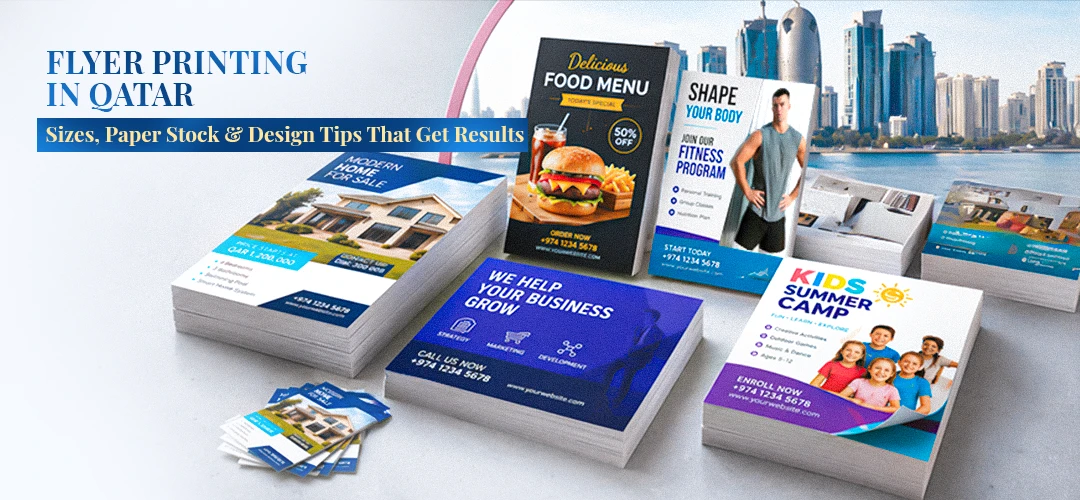
Most flyers get one look before they’re binned or kept. That’s not a design failure so much as how flyers work — they’re a five-second medium. Getting flyer printing in Qatar right means making that five seconds count: the right size for how it’ll be handed out, paper that doesn’t feel cheap in the hand, and a layout that reads at a glance.
Here’s what actually matters before you send a flyer to print.
Choosing the Right Size
A5 is the standard for mall handouts, restaurant table displays, and retail counters — compact enough to hold, large enough to carry a headline, an offer, and contact details without crowding.
DL (about a third of A4) suits till-point displays, brochure racks, and anything meant to sit in a stand rather than be handed out loose.
A4 works for posters, in-store notices, and flyers with more information to carry — event schedules, menus, price lists — where A5 would force the text too small to read comfortably.
A6 is the smallest common option, useful for postcard-style promos and event invites, but too small for more than a headline, a date, and a QR code.
Paper Stock: What Actually Changes
Weight is the first decision. 130–150gsm feels closer to a magazine page and suits most retail and F&B flyers; 170gsm and above starts to feel closer to a postcard and holds up better to repeated handling, which matters if the flyer is meant to sit on a counter for weeks rather than get handed out once.
Finish is the second. Gloss lamination makes colours pop and photos look sharp — a natural fit for food, retail, and anything image-heavy. Matte lamination reads as more premium and doesn’t show fingerprints the way gloss does, which suits real estate, professional services, and anything positioned as upscale. Spot UV — a raised gloss coating over specific elements like a logo or headline — adds a tactile highlight but is worth reserving for higher-budget runs since it adds a production step. For a deeper look at how paper choice affects the finished piece, see our guide to paper stocks.
Single-Sided or Double-Sided
Single-sided is the safer default when the flyer needs to be scanned quickly — a sale, an event, a single offer. Double-sided earns its keep when you genuinely have two distinct messages (a menu on one side, a delivery promo on the other) or want to include terms and conditions without cluttering the front. Printing both sides just to “use the space” usually backfires — most people never turn a flyer over.
Design Tips That Actually Move the Needle
Put the headline and the offer in the top third — that’s the part someone reads before deciding whether to keep going. Use one clear call to action, not three competing ones; “Visit us this weekend” beats a flyer that’s simultaneously asking for a call, a website visit, and a social follow. Leave real white space — a flyer crammed edge-to-edge with text and images reads as noise, and noise gets binned faster than sparse copy does. And if there’s a QR code, test it before the file goes to print; a code that doesn’t scan on the first try undoes everything else on the page.
Digital or Offset for Your Flyer Run
Flyers are one of the clearest cases for digital printing over offset — most runs are a few hundred to a couple of thousand copies, updated seasonally or per campaign, which plays to digital’s strengths on turnaround and low minimums. If you’re planning a much larger, longer-running distribution — think tens of thousands for a mall-wide campaign — offset starts to make more financial sense per piece.
What Affects Turnaround and Cost
Three things move the needle most: quantity, paper stock, and finishing. A simple single-sided A5 flyer on standard stock is one of the fastest and cheapest jobs we run; add spot UV, double-sided printing, and a heavier stock, and both cost and lead time go up. If you’re working to a hard deadline — an event date, a promotion start — flag it upfront so we can plan the finishing steps around it rather than around the flyer’s stock and quantity alone.
Frequently Asked Questions
What’s the most popular flyer size in Qatar?
A5 is the most common choice for retail, F&B, and event handouts — compact, affordable, and large enough for a clear headline and offer.
Is digital or offset better for flyer printing?
For most flyer runs — a few hundred to a couple of thousand copies, refreshed seasonally — digital printing is usually the faster, more cost-effective route. Very large, long-running campaigns can tip toward offset.
How long does flyer printing take in Doha?
Turnaround depends on quantity, finish, and current print volume, but simple single-sided flyers on standard stock are among the fastest jobs to produce. Add finishing like spot UV and lead time increases.
Should I laminate my flyers?
Lamination protects against handling and adds a premium feel, but it’s not essential for short-lived promotional flyers. It’s more worthwhile for flyers meant to stay on display for weeks.
Get Your Flyer to Print
Send us your file, quantity, and deadline, and we’ll tell you the fastest, most cost-effective way to print it — contact Speedline to get a quote moving today.