
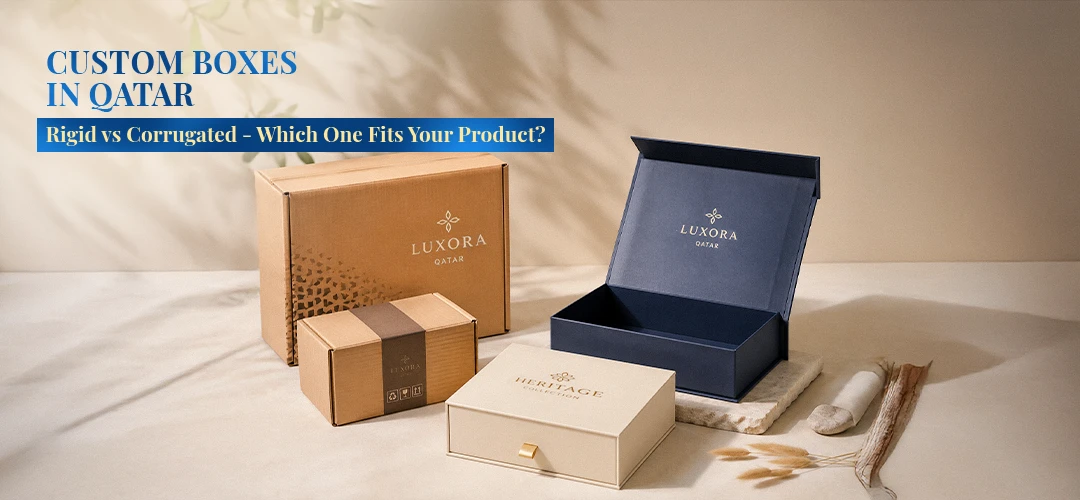
Almost every packaging brief we get in Qatar starts the same way: “we need a custom box.” The follow-up question we always ask back is whether that box needs to survive a courier van or sit on a shelf looking expensive — because those are two different jobs, and rigid and corrugated boxes are built for different ones.
Here’s how to tell which custom box actually fits your product, before you commit to a print run.
The Core Difference
Rigid boxes are built from thick, non-folding paperboard, usually wrapped in a printed or textured outer layer. They don’t collapse flat, they open with a slight resistance and a satisfying weight, and they’re the format behind most premium unboxing experiences — think phone boxes, perfume boxes, and gift sets.
Corrugated boxes use a fluted middle layer sandwiched between two flat sheets, the same structure behind shipping cartons everywhere. That flute is what gives corrugated its strength-to-weight advantage — it resists crushing, absorbs impact, and ships well, which is exactly what a box needs to do if it’s traveling through a courier network rather than sitting on a retail shelf. If you want more detail on how the material itself is built, see this overview of corrugated fiberboard.
Where Rigid Boxes Win
Rigid boxes make sense when the unboxing moment matters as much as the product — cosmetics, electronics, jewellery, corporate gift sets, and anything sold on perceived value as much as function. They also fold flat less often (some styles don’t fold at all), which means more storage space needed, and they cost more per unit than corrugated at equivalent volumes. That cost is usually the point: a rigid box signals a premium price point before the customer even opens it.
Where Corrugated Boxes Win
Corrugated is the obvious choice for anything shipped, stacked, or handled roughly — e-commerce parcels, food delivery packaging, bulk retail cartons, and moving or storage boxes. It folds flat for efficient storage and shipping before use, costs meaningfully less per unit than rigid, and takes printed branding well enough for most retail and delivery packaging needs, even if the print finish isn’t quite as crisp as what a laminated rigid box can achieve.
Branding and Print Options on Each
Rigid boxes typically take a wrapped printed sheet, foil stamping, embossing, or a magnetic-closure lid — all finishes suited to a slower, deliberate unboxing. Corrugated takes direct offset or digital print on the board itself, which is faster and cheaper to produce and better suited to logos, barcodes, and short delivery instructions rather than intricate premium finishes. If you’re weighing up finish options in more depth, our custom packaging boxes guide covers the full range we offer.
Cost and Lead Time
As a rule, corrugated costs less per unit and has a faster standard lead time, since the tooling and material are simpler. Rigid boxes cost more, largely because of the wrapping process and the thicker board, and typically need more lead time, particularly for custom die-cut shapes or added finishes like foil or magnetic closures. If your launch date is fixed, it’s worth flagging the format decision early rather than after the design is finalised — rigid box lead times can catch a tight timeline off guard.
A Simple Way to Decide
Ask what happens to the box after it leaves your premises. If it goes into a courier bag or a delivery bike box, choose corrugated — it’s built for exactly that kind of handling. If it goes straight into a customer’s hands as part of the product experience — a boutique purchase, a corporate gift, a retail display piece — rigid is worth the extra cost. Some brands genuinely need both: a corrugated shipper box on the outside, protecting a rigid presentation box on the inside. It’s not an either-or as often as it first seems.
Frequently Asked Questions
Which is cheaper, rigid or corrugated boxes?
Corrugated is generally cheaper per unit, thanks to simpler materials and a faster production process. Rigid boxes cost more but deliver a heavier, more premium unboxing experience.
Can corrugated boxes look premium?
With good print quality, spot finishes, and thoughtful die-cut structure, yes — but rigid boxes will still generally read as more premium out of the two, simply due to the material and construction.
Do rigid boxes fold flat for storage?
Most rigid box styles don’t fold flat, which means they take up more storage space than corrugated before use. This is worth factoring into your warehousing if you’re ordering in bulk.
Can I combine both formats for one product?
Yes — a common approach is a sturdy corrugated shipper on the outside for transit protection, with a rigid presentation box inside for the actual unboxing moment.
Get the Right Box for Your Product
Tell us what you’re packaging and how it travels — courier, retail shelf, or hand-delivered gift — and we’ll recommend the box format, size, and finish that fits. Get in touch with Speedline for a quote.